

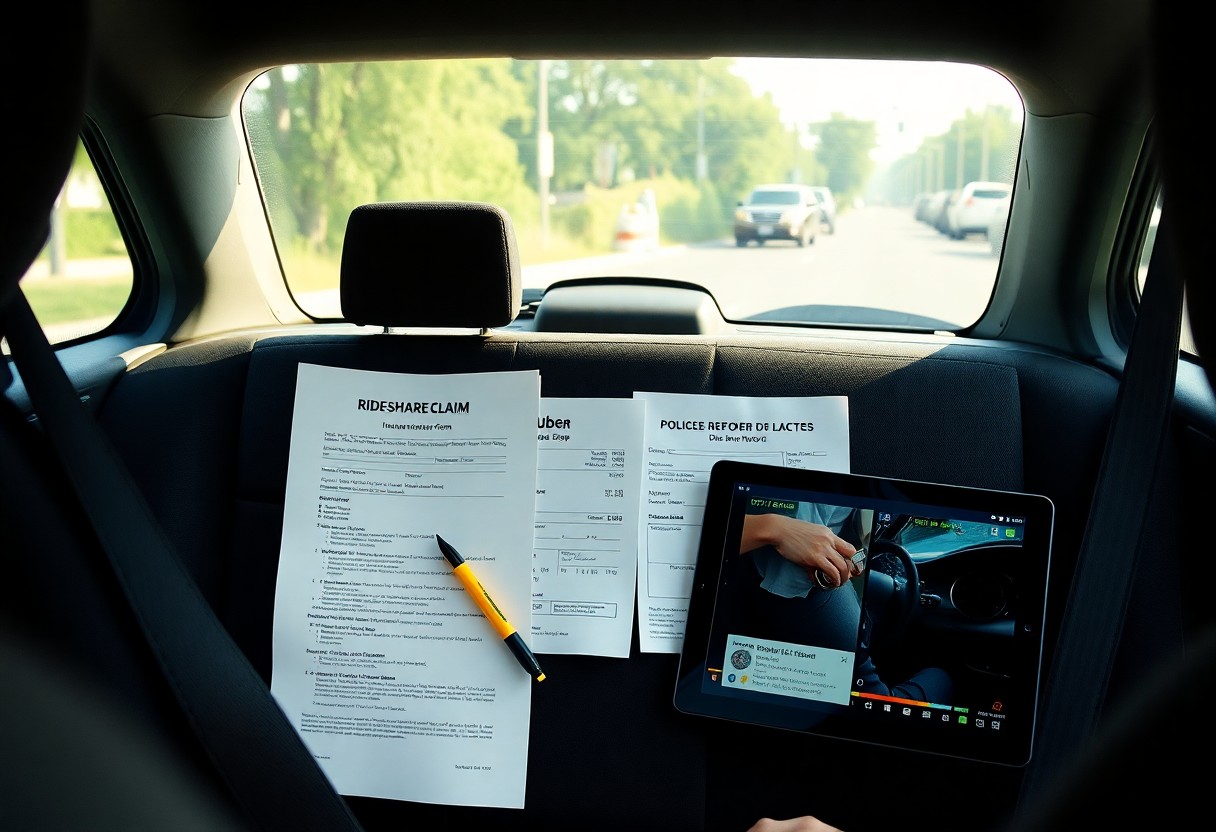
Most passengers think a rideshare claim is simple. However, if you want a Successful Uber Or Lyft Claim that gets you payment and protection, you must act quickly. First, seek immediate medical attention. Next, document your injuries and vehicle damage. Additionally, preserve photos, witness names, and the trip receipt.
Report the crash to the driver and the app, and notify your insurer. Follow your insurer’s instructions closely. Understanding the rideshare company’s insurance tiers and policy limits will help you demand fair compensation and avoid costly mistakes.
Remember, timing is critical in this process. Acting swiftly can significantly impact the outcome of your claim.
Key Takeaways:
- Prioritize safety and medical care, call 911 if necessary, document the scene with photos, get driver, vehicle and trip details, and obtain witness contacts and a police report.
- Report the incident through the Uber/Lyft app immediately and save any claim or reference numbers and correspondence screenshots.
- Notify your auto and health insurers promptly; determine which policy applies (personal policy, ride-share company coverage, or supplemental protection) and follow claim instructions.
- Keep organized records of medical treatment, bills, receipts, lost wages, repair estimates, and all communications related to the crash and claim.
- Consult an attorney for serious injuries or disputed settlements, and be aware of arbitration clauses, filing deadlines, and statute-of-limitations in your jurisdiction.
Understanding Your Rights as a Passenger
Overview of Rideshare Insurance Policies
You should know rideshare coverage switches by driver status: when the app is off the driver’s personal policy applies; while waiting for a match there’s usually contingent liability; and during an accepted trip the company’s commercial or third‑party liability often covers injuries and property damage. Policy limits commonly range from $1M for third‑party injury to lower limits for waiting periods, so you must track the driver’s status and gather trip timestamps if you’re injured.
Legal Rights When Using Uber or Lyft
You retain the same general personal injury rights as in any vehicle: you can pursue the at‑fault driver, the rideshare company under specific doctrines, and sometimes their insurer for medical costs, wage loss, and pain and suffering. If another motorist caused the crash, their liability is primary; if the rideshare driver was at fault while on a trip, the platform’s policy often becomes the main source of recovery.
In addition, you can request the driver’s trip records and the company’s crash report to support a claim; state laws differ, but many courts allow subpoenas or regulatory complaints to obtain evidence. Preserve photos, medical bills, and witness contacts immediately, and note whether the driver’s app showed “en route” or “waiting”-that status directly affects which insurer should pay.
- Passenger rights
- Subpoena evidence
- Trip status
- Medical bills
- Knowing you can file against the at‑fault driver, the rideshare insurer, or pursue uninsured/underinsured claims depending on the facts
Types of Claims You Can File
You can file claims against the at-fault driver’s personal policy or the rideshare company’s commercial policy, which is applicable when the driver is on a trip. You may also pursue uninsured/underinsured motorist coverage if needed. In some limited jurisdictions, you can bring a direct claim against the platform for negligent hiring or supervision.
Filing quickly preserves evidence and triggers insurer investigations that document liability and injuries.
| Claim Type | What It Covers / Notes |
| At‑fault driver | Property damage, medical bills, pain and suffering; first line if driver caused crash |
| Rideshare commercial policy | Often $1M liability during rides; may cover passenger injuries when trip accepted |
| Contingent/period coverage | Lower limits while waiting for a match; depends on app status |
| Uninsured/underinsured (UM/UIM) | Use your policy if other at‑fault driver lacks coverage or limits are insufficient |
| Direct claims/regulatory | Negligent hiring/supervision claims against platform in some states; file regulatory complaints |
For each claim, gather the driver’s name, license, trip receipt, photos, and detailed medical records; insurers focus on timelines and causation, so precise timestamps and witness statements boost recovery. If limits are insufficient, you may combine remedies-file a liability claim and a UM/UIM claim or pursue a third‑party lawsuit to recover non‑economic damages.
- At‑fault driver claim
- Rideshare insurer
- Uninsured/underinsured
- Regulatory complaint
- Knowing you should preserve evidence, document timelines, and notify insurers promptly to maximize compensation
Factors to Consider Before Filing a Claim
- rideshare claim timing and deadlines
- scope of insurance (driver vs. platform coverage)
- evidence you can collect for compensation
- potential shared fault and state liability rules
- medical costs, lost wages, and policy limits
Assessing the Severity of Your Injuries
You should get medical attention immediately for any head trauma, fractures, loss of consciousness, or visible bleeding. Even soft-tissue symptoms that persist beyond 48-72 hours can lower your claim’s credibility. If an ER visit documents your injuries within 24 hours, adjusters will treat it as stronger evidence.
This can increase your settlement value when combined with imaging, bills, and a treating provider’s notes. Always seek medical care and keep comprehensive records.
Documenting the Incident Thoroughly
Take multiple photos of vehicle damage, road conditions, traffic signals, your injuries, and the ride receipt; collect the driver’s name, license plate, insurance, and any witness contacts, and request the police report number at the scene. Immediate documentation-within minutes to hours-greatly strengthens your position, and digital timestamps are persuasive to insurers. Photos and a police report are especially valuable.
When documenting, aim for redundancy: shoot exterior and interior vehicle angles, close-ups of injuries, and wide shots showing lane positions and signage; record the timestamp, GPS snapshot or map link, and short voice notes describing events. Ask witnesses for written statements or videos; preserve the in-app ride receipt and any chat messages. If possible, request dashcam or nearby CCTV and note the responding officer’s name and report number for the file.
Understanding Fault and Liability
Determine who caused the crash and whether the driver was on-trip (accepting or transporting a passenger), en route to a pickup, or offline, since platform coverage often applies only during specific app statuses. Traffic citations, witness statements, and the police report directly affect how fault is allocated; in many states, comparative negligence will reduce your award by your percentage of fault. Fault matters for payout.

Expect multiple liable parties in many incidents: the rideshare driver, another motorist, a municipality for a defective signal, or a vehicle manufacturer. Use citations and the police narrative to assign responsibility, and note whether the driver was logged into the app-this determines whether the platform’s higher policy limits (often up to $1,000,000) may apply. Collecting evidence that pins primary fault on another party increases your settlement odds.
Evaluating Insurance Coverage
Check whether the driver’s personal policy applies, whether the platform’s contingent commercial policy is active (commonly up to $1,000,000 during a trip), and whether you can tap your own PIP or health insurance for immediate bills. Also verify uninsured/underinsured motorist protection and any gap coverage in the driver’s jurisdiction; insufficient limits commonly force you to seek alternative recovery routes. Policy limits determine potential compensation.
Request the driver’s declarations page and the insurer’s contact; confirm the app status timestamped in the platform’s trip log to establish which coverage period applies. If bills exceed the available limits, quantify economic losses-medical bills, 52-week wage estimates, and rehabilitation costs-to present a demand. Consulting an attorney when damages approach or exceed policy limits often yields a faster, higher recovery.
How to Collect Evidence
Gathering Medical Records
Request all treatment records: ER reports, imaging (X‑ray, CT, MRI), physician and PT notes, prescriptions, and itemized bills with dates of service. Ask for discharge instructions and billing codes if available, and use a HIPAA authorization so providers release records quickly-many respond within 30 days. Keep paper and digital copies; ER reports and imaging results often determine causation and settlement value.
Taking Photographs of the Scene
Photograph the scene from multiple angles immediately: wide shots of the overall position, medium shots of each vehicle and road features, and close‑ups of vehicle damage, license plates, skid marks, traffic signs, and your visible injuries. Aim for at least 10-15 images, enable timestamps/GPS, and avoid filters or edits so originals remain admissible.
Use a repeatable checklist: three wide-angle photos for context, four mid-range to show distances and landmarks, and five close-ups of dents, glass, and injuries. Place a common object or ruler for scale when possible, and record a short video walkthrough to show continuity. Preserve EXIF metadata by backing up originals to cloud storage; metadata proving timestamps and GPS markedly strengthens your claim.
Obtaining Witness Statements
Get full names, phone numbers, emails, and a brief written or recorded account from every witness-target at least two independent witnesses. Ask them to state where they stood, what they saw, approximate times, and whether the driver seemed distracted or impaired. If possible, have them sign or text a short statement; independent eyewitness testimony greatly increases credibility.
Use a short template to keep statements consistent: location, time, what was observed, vehicle behavior, and any estimating of speed or direction. Always ask permission before recording-if you’re in a two‑party consent state obtain explicit consent first. When available, request a photo of the witness ID and an emailed statement; corroborating witness audio or video has decided many claims in the claimant’s favor.
Keeping a Detailed Account of Events
Maintain a contemporaneous log with dates, times, locations, symptom descriptions using a 0-10 pain scale, treatments, medications, appointment times, and missed work or expenses. Save pay stubs, receipts, and appointment confirmations. Update your log within 24 hours of events so entries reflect what actually happened; accurate timelines and documented lost wages directly affect settlement calculations.
Choose a single method-physical notebook, timestamped app, or dated photos-and be specific: for example, “7/12 8:15 PM pickup; 8:37 collision; 9:05 PM ER visit for cervical strain, pain 4/10; missed 2 workdays, $320 lost wages.” Consistent, contemporaneous entries paired with receipts and medical notes are far more persuasive to adjusters and juries than later recollections.
The Claims Process Explained
Notifying the Rideshare Company
After an accident you should notify the rideshare company through the app’s Safety Center or Help > Report an Accident and file a police report if anyone is hurt or there’s significant damage; companies expect notification as soon as possible, ideally within 24-48 hours, and you should upload photos, the driver’s info, and the police report number to the claim.
Submitting Your Claim
Gather evidence before you file: photos, contact details for the driver and witnesses, the trip receipt/ID, medical bills, and the police report; submit these through the rideshare claim portal and to your insurer, and keep copies of every form and receipt you send.
When you complete the claim, attach itemized medical records, receipts, and dates of treatment, plus the driver’s name, license plate, and the trip ID or timestamps from the app; the company will check app logs and GPS, and if the driver was on-trip their commercial coverage (often up to $1,000,000 third-party liability) may apply-so present clear documentation and do not sign a full release until your treatment and future-care needs are settled.
Key Deadlines to Keep in Mind
Report the crash to the app immediately and notify your insurer promptly; in practice companies expect initial notice within 24-72 hours, while many insurers require claim notice within 30 days, and statutory time limits for lawsuits (the statute of limitations) vary by state, commonly ranging from 1-6 years.
State-by-state variation matters: for example, California gives you 2 years to sue for personal injury and 3 years for property damage, so you should file claims and preserve evidence well before those windows close; missing insurer or company deadlines can result in denial or weakened recovery.
What to Expect During the Review Process
An adjuster will contact you for a statement, request records, and pull the driver’s trip logs and GPS; simple liability and medical-only claims often resolve in 30-90 days, while disputes, complex injuries, or missing documentation can extend that timeline substantially.
During review expect multiple document requests, potential recorded statements, and possibly an independent medical exam (IME); the company may seek subrogation against the driver’s policy, offer a settlement, or deny the claim-if you receive a low offer, consider consulting an attorney before accepting or signing anything that waives future claims, since signing a full release can forfeit compensation for later-discovered injuries.
Tips for Maximizing Your Claim
- Preserve evidence: photos, dashcam, and witness contact info immediately after the crash.
- Seek medical care and follow-up notes to link treatment to the incident.
- Track lost wages, receipts, and transportation costs for your claim.
- Avoid unsupervised recorded statements; get key facts in writing from the adjuster.
- Consider consulting a lawyer early-many offer free consults and work on contingency.
Seeking Legal Advice Early On
You should get a consult with a rideshare injury attorney within weeks, since many states have a two‑year statute for personal injury suits and insurance timelines move fast; typical contingency fees run around 33%-40%, but attorneys can often boost net recovery beyond the insurer’s first offer.
Staying Organized with Documentation
Keep a single, dated file-paper and cloud-with medical records, bills, photos, and a daily symptom log so you can prove causation and damages if the insurer disputes the scope of your injuries or treatment.
Use a consistent naming system (YYYYMMDD_type) and save originals; scan every ER report, imaging result, and physical‑therapy note. Store pay stubs, employer absence confirmations, and receipts for rides, medications, and childcare; preserve photo metadata and geolocation when possible. Track each communication by date, time, person, and summary, and keep claim numbers, adjuster names, and policy references together so you can produce a coherent timeline in negotiations or court.
Communicating Effectively with Insurance Adjusters
Be factual and concise: give the adjuster dates, injury descriptions, and treatment plans, but politely decline lengthy recorded statements until you’ve consulted counsel and never accept a quick verbal settlement without documentation.
When you speak, start by recording the adjuster’s name, company, file number, and the scope of what they’re evaluating; ask for written confirmation of offers and what evidence they need. If you receive a lowball number, request a detailed breakdown and provide medical bills and lost‑wage proof to justify higher demand; use email so there’s a written trail and summarize phone calls in follow‑up messages.
Understanding Settlement Offers
Evaluate offers by comparing medical expenses, projected future care, lost earnings, and non‑economic damages; the insurer’s first offer is often a low quick‑close attempt, and signing a broad release without full recovery for future treatment can leave you paying later.
Learn the difference between lump‑sum and structured settlements, and consider future medical needs-multipliers for pain and suffering commonly range from 1.5-5 depending on severity and permanence. Insist on a release that lists covered claims and preserves unresolved medical liens; obtain a CPA or attorney review for complex tax or vocational‑loss issues. Knowing how to weigh short‑term cash against long‑term costs will improve the outcome of your Uber or Lyft claim.
Factors That Can Delay Your Claim
- Liability disputes between drivers, passengers, and companies
- Confusion over insurance layers for Uber and Lyft
- Medical billing, liens, and late records
- State rules and filing deadlines that affect compensation
Complications in Liability Determination
You often face delays when insurers argue whether the driver was on-duty, available-for-hire, or carrying a passenger; platforms use GPS and trip logs to defend status, and disputes over a few minutes of app activity can stall investigations for weeks while both sides collect trip data and witness statements.
Issues with Insurance Coverage
Insurers frequently delay payment while sorting which policy applies: the driver’s personal policy, the rideshare company’s contingent policy, or the company’s commercial policy – many cases hang on whether the incident occurred during an on‑trip period when carriers may provide up to $1,000,000 liability coverage.
Insurer coordination can trigger long verification cycles: expect requests for formal denials from the driver’s carrier, subpoenas for app logs, and subrogation inquiries; you should obtain written denials, preserve screenshots of the ride, and track timeline details so adjusters can reconcile overlapping insurance responses faster.
Delays in Medical Billing or Records
Claims often stall because hospitals and specialists submit itemized bills or liens months after treatment; insurers may decline settlement until they receive final bills, creating gaps between your treatment dates and the paperwork they need to evaluate medical losses.
Providers can place liens or assign bills to collections, which forces negotiations before insurers will release funds; request itemized statements, authorize records releases promptly, and get written estimates for future care – these steps reduce back-and-forth and keep your claim moving.
Navigating State-Specific Laws
State regimes like no-fault rules, mandatory arbitration, or different liability thresholds affect how claims are processed; for example, no-fault states can require you to use PIP before suing, and statute of limitations windows (commonly 2-3 years) determine filing urgency for compensation.
Local court procedures and regulator requirements can add layers: some states mandate insurer notices within fixed days, others require pre-suit demands or medical threshold proof – identify your state’s timelines, check whether your state treats rideshare as commercial, and factor those rules into your documentation strategy.
Knowing which specific delay applies lets you prioritize documents, preserve evidence, and push the right parties for faster resolution of your Uber/Lyft claim.
Conclusion
Taking this into account, you can efficiently start a Successful Uber Or Lyft Claim by documenting the scene, seeking medical care, promptly notifying the rideshare company and your insurer, and preserving all records and receipts. Follow policy timelines, provide clear evidence, and be persistent when negotiating settlements. Consult an experienced attorney if liability or compensation is disputed.
Staying organized and proactive maximizes your chances of fair insurance recovery.
FAQ
Q: What are the immediate steps a passenger should take after an Uber or Lyft crash?
A: Ensure everyone is safe and call 911 if there are injuries. Move to a safe location if possible. Take photos and video of the vehicles, damage, skid marks, road conditions, traffic signals, and your visible injuries. Get the driver’s name, contact information, license plate, and insurance details; collect witness names and phone numbers. Report the incident in the Uber/Lyft app and obtain the trip ID or receipt. Seek medical attention promptly and keep all medical records and bills; even minor injuries should be documented. File a police report and obtain the report number and officer contact information.
Q: How does Uber/Lyft insurance protect passengers and how does coverage change based on app status?
A: Coverage depends on the driver’s app status: when the driver is offline, only the driver’s personal auto policy applies. When the app is on but no passenger is in the vehicle (available or en route to pick up), a limited contingent liability policy often applies. When the driver has accepted a ride and is en route to pick up or has a passenger in the car, the company provides primary liability coverage that commonly includes high limits (often up to $1 million), and may include uninsured/underinsured motorist (UM/UIM) coverage and contingent collision coverage depending on the company and state. Exact protections and limits vary by state and by whether the driver carries collision coverage; check the company’s insurance disclosures for your jurisdiction.
Q: What documentation and evidence will strengthen my claim for compensation?
A: Preserve the trip receipt and trip ID, app screenshots showing time and driver information, photos and videos of the scene and injuries, the police report, medical records, treatment notes, bills, receipts for out-of-pocket expenses, wage-loss documentation, and witness statements or contact information. Keep a contemporaneous diary of symptoms, treatment, and recovery. Save all communications with the driver, the rideshare company, and insurers. Secure repair estimates or vehicle valuation if personal property was damaged. Organizing chronological records and copies of originals speeds claim processing and strengthens credibility.
Q: How do I file a claim with Uber/Lyft and my own insurance company, and what deadlines should I watch for?
A: Report the crash through the Uber or Lyft app and through the company’s online claims portal; follow up by phone if necessary and obtain a claim number. File a police report and notify your personal auto insurer and health insurer if applicable. Submit medical records, receipts, and evidence requested by adjusters, and keep records of all claim references. Be aware of statute-of-limitations deadlines for personal injury lawsuits in your state and any company claim-reporting windows; deadlines vary, so act promptly. Do not sign broad medical release forms or accept a settlement offer without reviewing the full payoff and consequences; consult an attorney if the offer is low or liability is disputed.
Q: When should I hire an attorney and what types of compensation can I pursue?
A: Consult an attorney if you have significant injuries, disputed fault, complex coverage issues, permanent impairment, or if the insurer’s offer seems inadequate. An attorney can pursue economic damages (medical bills, future care costs, lost wages, property damage), non-economic damages (pain and suffering, loss of enjoyment), and in some cases punitive damages. Attorneys typically work on contingency, advance costs, and negotiate with insurers or file suit if necessary. Expect timeline variability: minor claims may settle in months, serious injury claims can take a year or more to resolve. Ask potential lawyers about experience with rideshare cases and fee structure before retaining one.


