
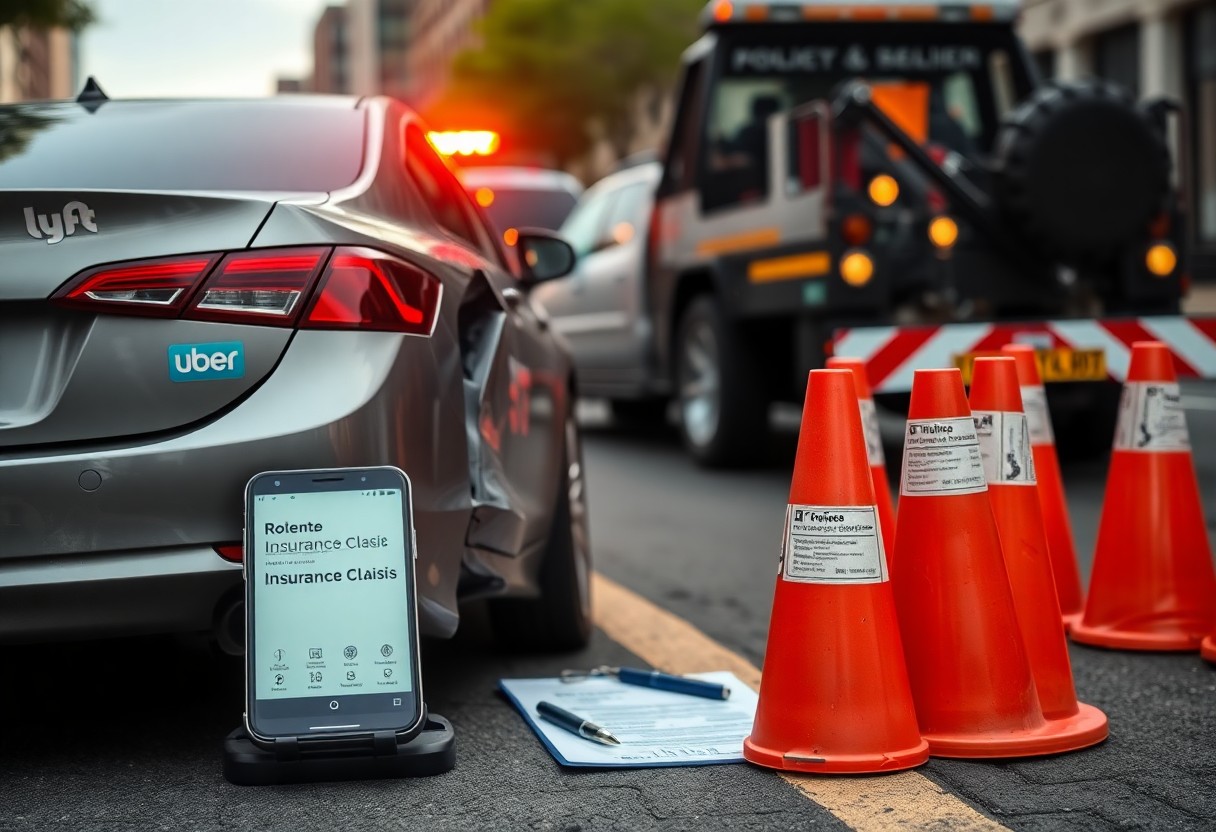
Many people are unsure what to do after a Uber Or Lyft Claim collision, but you can take clear steps to secure recovery: seek medical attention, document everything (photos, driver and witness info), notify the rideshare company and insurance, and file your claim promptly to meet deadlines while an attorney helps you protect your rights and maximize compensation.

Key Takeaways:
- Prioritize safety and get medical help immediately-call 911 at the scene and follow healthcare guidance.
- Document everything: photos and video of damage, road conditions, injuries, and witness names/contact details.
- Preserve trip and driver info-save app screenshots, driver profile, license plate, and any messages; avoid recorded statements to insurers without advice.
- Notify the rideshare company via the app and your insurer promptly; keep all medical bills, repair estimates, and receipts.
- Consult an experienced rideshare attorney early for serious injuries to determine applicable insurance layers, protect rights, and meet deadlines.
Understanding Uber Or Lyft Claim Accidents
What Defines a Rideshare Accident
If you’re involved in a collision while riding in or driving for a platform like Uber or Lyft, it qualifies as a rideshare accident when the incident occurs during any portion of a ride request, en route to pick up a passenger, or while carrying a passenger. App status and time-stamped trip logs often determine whether the crash is treated as a personal auto claim or a commercial rideshare claim, so preserve screenshots and the trip receipt immediately.
Common Causes of Rideshare Accidents
Distraction from app navigation or passenger interactions, speeding to reach pickups, and driver fatigue from long shifts are frequent causes you’ll encounter. Other common factors include impaired driving on late-night runs and sudden lane changes to reach a pickup location. Distracted driving from using the rideshare app is especially dangerous because it combines navigation and customer communication in real time.
More specifically, you should watch for patterns: drivers entering addresses while moving, accepting multiple consecutive fares to boost earnings, or driving at peak surge times can elevate risk. Weather and unfamiliar pickup/dropoff points-think narrow apartment entrances or busy rideshare zones-also increase the chances of collisions and property damage, so document road and lighting conditions when possible.
Who is Liable in a Rideshare Accident
Liability often hinges on the driver’s app status at the crash moment. If the driver wasn’t logged in, their personal insurance typically applies; if they were logged in and en route or with a passenger, the rideshare company’s commercial policy usually steps in. App timestamps, trip receipts, and police reports are your strongest evidence to show which insurer should respond.
To build your claim, capture the driver’s name, vehicle, license plate, and a screenshot of the app status or trip confirmation. File a police report and notify both the rideshare company and your insurer promptly. In many disputes, independent witnesses, dashcam footage, and medical records tip the balance toward the correct insurer paying for medical bills and damages.
How to Start Your Rideshare Claim
Steps to Take Immediately After an Accident
Immediately call 911 if anyone is injured; if not, move to a safe spot and exchange names, phone numbers, insurance details, and license plates. Provide only factual answers and do not admit fault. Ask for a police report and get the report number. Photograph vehicle positions and visible injuries, and seek medical attention within 72 hours, since early treatment often affects claim outcomes.
Collecting Evidence at the Scene
Photograph and video every angle of vehicle damage, license plates, VIN, road signs, skid marks, traffic signals, and visible injuries; capture the rideshare app screen showing the trip status and driver profile. Obtain witness names and phone numbers and record brief statements on your phone. Save timestamps and GPS coordinates from photos-metadata often ties events to exact times and locations.
Take wide shots to show the overall scene plus close-ups of specific damage, odometer readings, and any interior harm like deployed airbags or seatbelt marks. Record a 360° video, screenshot the trip receipt, and photograph the driver’s permit or badge. Back up original image and video files to cloud storage or email them to yourself to preserve unedited metadata.
Contacting Your Rideshare Company
Report the crash through the app’s “Get help” or “Report an Accident” feature and upload the police report number, photos, and witness contacts; file this within 24 hours if possible. Use the rideshare safety hotline for serious injuries and avoid detailed admissions beyond the facts. Keep copies of every submission and the claim reference you receive.
After filing, note the confirmation or claim ID and follow up if you don’t get a response within 48 hours. If the driver was on a trip, Uber and Lyft often provide up to $1,000,000 third-party liability during on-trip coverage; if the driver was offline, personal insurance usually applies. Forward all insurer or company correspondence to your attorney and preserve receipts, medical bills, and repair estimates.
How to Document Your Claim
Importance of Medical Records
Medical records are often the backbone of your claim. Get immediate care and document every visit, diagnosis, imaging (X-rays, CT scans, MRIs), prescription, and referral; insurers focus on contemporaneous documentation. Make sure you request copies of discharge notes, treatment notes, and billing codes-store them electronically and physically for at least five years. If you delay care beyond 48-72 hours you may face credibility disputes; prioritize obtaining complete records and linking them to the crash date.
Maintaining a Detailed Accident Journal
Start a daily accident journal as soon as possible: record date/time, activities at injury, pain level (0-10), symptom location, meds, sleep disruption, mobility limits, and lost work hours with dollar amounts. Attach photos of bruising, swelling, and vehicle damage on days 1, 3, and 7 to show progression. A contemporaneous log converts scattered facts into a clear timeline that supports both damages and causation.
Use a consistent format-date, time, brief symptom description, pain score, and action taken-and keep entries daily for the first 30 days, then weekly until recovery. Include receipts, appointment confirmations, therapy notes, mileage, and screenshots of ride logs or messages. If you use a phone app or a bound notebook, timestamp entries and scan pages; counsel and adjusters rely on chronological, signed, and dated entries when assessing lost wages and ongoing care needs.

Gathering Witness Statements
Collect full contact information for every witness-name, phone, email-and get a short written or recorded account of what they saw; that contact info is often the most valuable evidence. Ask witnesses to note vehicle positions, signal use, and who moved first. Whenever possible obtain a signed, dated statement and a photo of the witness at the scene to preserve identity and context for later interviews.
Ask specific questions: where were you standing, which vehicle did you see initiate movement, approximate speeds, traffic signal status, and whether you observed distraction (phone use, passenger activity). Try to record audio/video with consent or at least type their account into your phone and have them initial it. Secure witness details within 24-72 hours while memories are fresh, and ask if they saw nearby CCTV or business cameras so you can request footage through your attorney or the insurer.
Tips for Dealing With Insurance Companies
- Report the crash to the app and insurer within 24 hours to preserve coverage and evidence.
- Document injuries, photos, and receipts so you can prove damages during negotiations.
- Preserve communications-do not give recorded statements until you know the full scope of your claim.
Understanding Rideshare Insurance Policies
When the app is off, your personal insurance typically applies; when you’re logged in and waiting for a match, many platforms supply limited third‑party liability (commonly around $50,000/$100,000/$25,000 in many states); once you’re en route or carrying a passenger, commercial coverage often rises to as much as $1,000,000 for third‑party claims-so verify which policy phase applies to your incident.
Communicating Effectively with Insurance Adjusters
Answer calls professionally, stick to verifiable facts about the crash, and provide vital documentation like medical records and photos; avoid speculation about fault and do not give recorded statements until you understand the full extent of your injuries.
Be aware adjusters often test the strength of your claim: if an adjuster asks about pre‑existing conditions or pressures you for a quick settlement, reply that you’ll provide requested records in writing and that you’re consulting counsel; log call times, get offer details in writing, and treat any initial number (for example, a quick offer under $5,000) as exploratory rather than final.
Avoiding Common Pitfalls with Offers
Insurers may present fast, low offers and ask you to sign a release; if you accept payment and sign, you typically waive future claims-so protect your right to full recovery by withholding signatures until damages are fully assessed and your settlement reflects medical bills, lost wages, and future care.
Demand an itemized offer and compare it to documented damages: total medical bills, documented time off work, and projected future treatment; a rough valuation method is to multiply economic damages by a severity factor (commonly 1.5-5×) to estimate pain and suffering, and always ask for the insurer’s full justification for any low number-The safest move is to consult an experienced rideshare attorney before accepting any settlement.
Factors to Consider When Filing Your Claim
- Rideshare accident
- Uber claim
- Lyft claim
- Policy limits
- Statute of limitations
- Comparative fault
- Medical bills
- Lost wages
Determining the Value of Your Claim
Start by totaling your out-of-pocket costs-medical bills, vehicle repairs, and documented lost wages-then add future treatment and a pain-and-suffering estimate; insurers often use a multiplier between 1.5-5× your economic damages depending on severity, permanent impairment, and lost earning capacity. You should collect bills, wage stubs, and doctor opinions to support higher valuations and to show how the rideshare accident produced ongoing care needs.
Time Limits for Filing Claims
Many states set a statute of limitations of roughly 2-3 years for personal injury suits (for example, California is 2 years, New York is 3 years); additionally, insurers and rideshare platforms may expect prompt notice-sometimes within 24-72 hours-to avoid claim complications. You must file suit before the deadline or risk losing the right to sue.
Calculate your deadline from the date of the crash or from discovery of injury if the state applies a discovery rule; tolling can extend deadlines for minors or defendants who leave the state, but missing the window typically results in a court dismissal. You should preserve evidence immediately-photos, medical records, app trip data and witness info-because later disputes over timing or causation become harder to resolve when documents are absent.
Impact of Fault on Your Claim
States use different rules-pure comparative, modified comparative (50% or 51% bar), or contributory negligence-so your recovery will be reduced by your percentage of fault; for instance, if total damages are $100,000 and you’re deemed 30% at fault, you’d typically recover about $70,000 before other offsets. Collecting clear evidence can limit how much fault is assigned to you.
Evidence that shifts fault-police reports, dashcam/GPS data from the rideshare app, photos showing vehicle positions, and independent witness statements-often changes negotiations dramatically; insurers run arithmetic using the assigned fault percentage to make settlement offers, so lowering your fault from 30% to 10% on a $50,000 claim increases your net recovery by roughly $10,000. Use depositions and medical timelines to show causation and minimize comparative fault.
Knowing these timelines, valuation methods, and fault dynamics lets you prioritize evidence, preserve legal rights, and negotiate from a realistic position.
Protecting Your Rights
When to Seek Legal Representation
If you suffer hospitalization or permanent injury, have medical bills over $10,000, face disputed fault, or multiple insurers are involved, you should strongly consider counsel; lawyers often recover higher settlements on claims involving complex liability or lowball offers. Statutes of limitation typically range from 1-3 years, and rideshare policies commonly provide up to $1,000,000 when a driver is on-trip, making timely legal action important.
Knowing Your Rights as a Rideshare Passenger
You have the right to seek compensation from the driver’s insurer, the rideshare company’s insurer, and any at-fault third parties for medical bills, lost wages, and pain and suffering. Trip logs and GPS timestamps can prove an on-trip status that may trigger a $1,000,000 commercial policy; you can also request the police report, medical records, and witness statements to support your claim.
Act quickly to preserve evidence: photograph injuries and vehicle damage, collect witness names, and get immediate medical attention. File an incident report through the app within 24-72 hours if possible, save all messages from the driver, and do not sign any release or give recorded statements to insurers until you understand the full scope of losses.
Handling Claims with Multiple Parties
When another motorist, the rideshare driver, and the rideshare company are involved, claims often include three or more insurers and apportionment under comparative negligence rules; for example, if you’re found 20% at fault, your award can be reduced by 20%. Complex liability matters commonly require coordinating claims to protect recovery against multiple policies.
Identify every potentially liable party and all applicable policies, notify insurers promptly (typically within a 14-30 day window), and preserve medical and wage records. Use your UM/UIM coverage if needed, avoid early settlement offers, and let insurers handle subrogation so you don’t inadvertently waive rights while claims against other parties proceed.
Summing up
Ultimately you should prioritize your safety and health, document the scene and injuries, notify the rideshare company and your insurer promptly, and preserve evidence and medical records; file required claims within deadlines, avoid recorded statements without legal advice, and consult an experienced attorney when liability or serious injuries arise so you can protect your rights and maximize compensation.
FAQ
Q: What should I do immediately after a rideshare accident?
A: Ensure safety and call 911 if anyone is injured. Move to a safe location if possible, exchange names, phone numbers, license and insurance information with the rideshare driver and any other drivers, and collect contact details for witnesses. Take clear photos and video of vehicle positions, damage, skid marks, visible injuries, traffic signs, and the scene from multiple angles. Do not admit fault or sign forms without reading them; get a police report number and the responding officer’s name. Seek medical evaluation even for minor injuries and keep all medical records and bills.
Q: How do I report the crash to Uber or Lyft and what information should I provide?
A: Use the app’s “Help” or “Safety” section to report the incident as soon as possible and follow the prompts to submit a crash report; both companies provide in-app claim/report options and emergency support. Provide the trip ID, date/time/location, photos, police report information, and a concise description of what happened. Ask for the rideshare company’s claim number and request any available insurance information for the driver. If a third party caused the crash, notify your insurer and the at-fault driver’s insurer and preserve all app screenshots, messages and trip receipts.
Q: Whose insurance pays after an Uber or Lyft crash and what coverage is available?
A: Coverage depends on the driver’s app status at the time: when the driver is offline, their personal policy typically applies; when logged in but waiting for a ride match, the company’s contingent liability may apply (often limited); when en route to pick up a passenger or with a passenger, the rideshare company’s commercial liability and uninsured/underinsured motorist coverages usually apply, often with higher limits. You may also have Personal Injury Protection (PIP) or medical payments through your own auto or health insurance. For serious injuries, the commercial policy can cover medical expenses, lost wages, pain and suffering, and property damage up to policy limits; if limits are insufficient, pursue claims against the at-fault driver and any other responsible parties.
Q: What evidence and documentation will strengthen my claim?
A: Photos and video from the scene, dashcam or phone footage, the rideshare trip receipt and trip ID, the police report, witness contact information and statements, medical records and diagnoses, bills and receipts for treatment, wage statements or proof of lost income, vehicle repair estimates and receipts, and any communication with insurers or the rideshare company. Preserve original clothing and phone logs if they relate to the crash. Maintain an organized file and avoid deleting app history or messages related to the ride.
Q: When should I hire an attorney and what will they do for my rideshare claim?
A: Consult an attorney if you have a serious injury, disputed fault, multiple liable parties, unclear insurance coverage, low settlement offers, or complex medical liens and subrogation issues. An attorney will investigate the crash, obtain evidence (including app and insurance records), calculate damages (medical costs, future care, lost wages, pain and suffering), prepare a demand package, negotiate with insurers, and file suit if necessary. They can also protect your rights during recorded statements, and ensure statute-of-limitations deadlines are met (statutes vary by state; check local deadlines promptly). Attorneys commonly work on contingency, advancing costs and getting paid from any recovery.


